
KN Magazine: Articles
Drop the Pen! What Every Writer Needs to Know About Real Police Work: Police Batons
In this installment of Drop the Pen!, David Lane Williams explores the history, use, and realities of police batons, offering writers an insider’s perspective on how and when these “less lethal” tools are actually deployed. Blending firsthand experience with practical guidance, the article helps writers portray law enforcement with greater accuracy and nuance.
By David Lane Williams
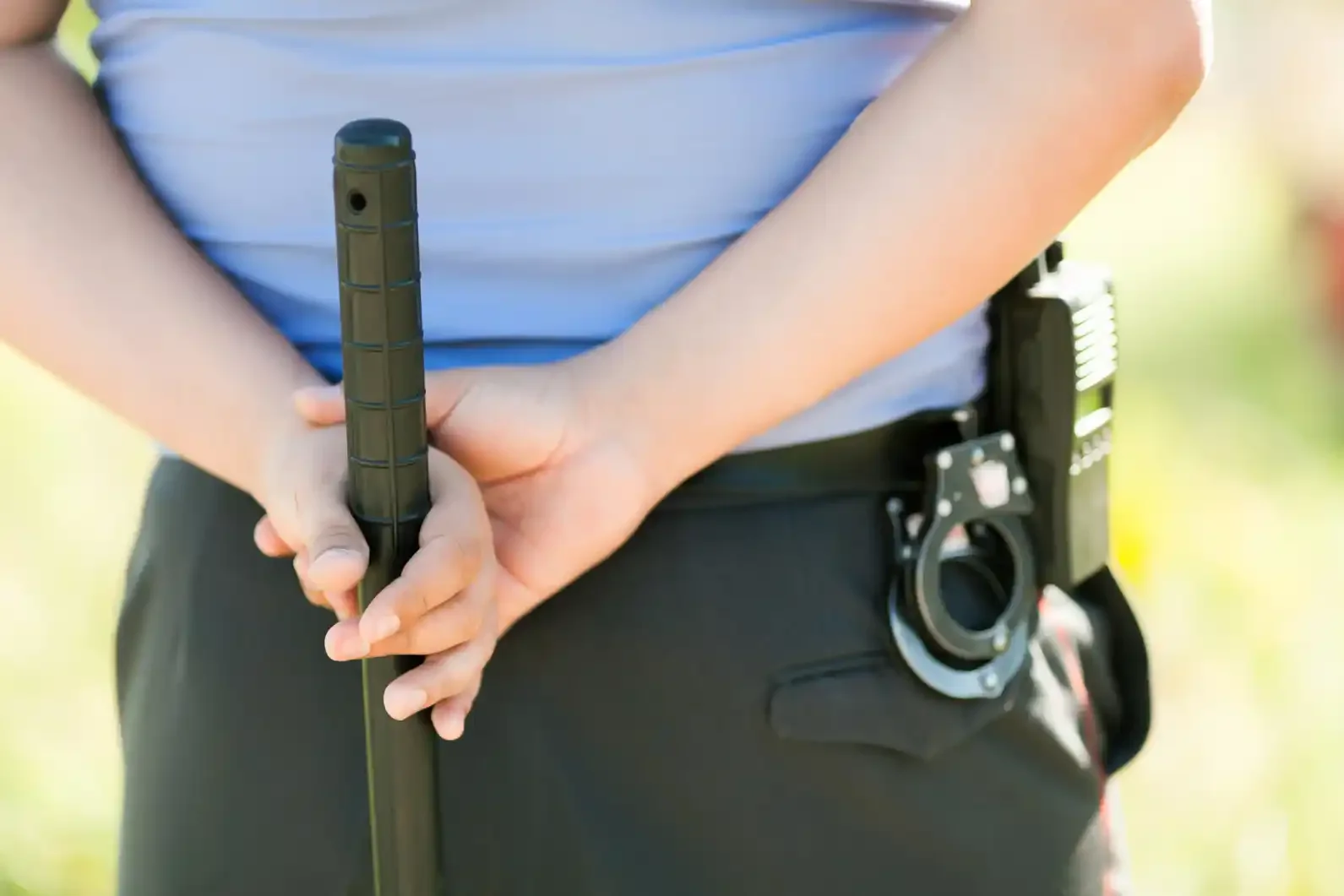
One of the most frequently asked questions I get at writer’s events when I speak or sit on discussion panels has to do with police weapons other than firearms. Writers want to understand how and when such tools are utilized, as well as the training involved. Tasers and pepper spray always come up, but occasionally someone wants to get a better grasp on police batons for a scene they're writing.
One of the early roles in policing in Western Europe and the fledgling American colonies was that of the Night Watchman. Often these people patrolled what we would now call the Red-Light district of his town or city, charged with keeping the peace—or at least keeping the ruckus relatively quiet so that the folks in the swanky part of town weren’t disturbed. There was no training curriculum or written policy manual. The men hired on (often just for a night or two to make enough for a few pints) were almost always from the same neighborhood they patrolled, often just as likely to get into a knife fight, gamble, or hire a lady of the evening as the people they’d been hired to manage.
A night watchman was usually a large fellow, willing to get into a physical scrape but menacing enough that most people wouldn’t take him on. Just in case, though, night watchmen are always depicted as carrying some type of club. This “billy club,” a name derived from burglar slang for a short bar or length of wood used to pry or bust windows, became a symbol for the long (and potentially brutal) arm of the law.
Flash forward in history to Rodney King, a man whose assault at the hands of Los Angeles police officers after a high-speed pursuit was filmed on a newfangled device called a handheld video recorder in 1991. The footage of the incident was seen by millions internationally, and a new era of the public documenting and broadcasting actions taken by their government began.
The officers who struck King so relentlessly were using a style of baton called the PR 24. The PR 24 came with a handle jutting out perpendicular from one end of the stick, which allowed for a variety of techniques, such as swinging it with greater speed, using it on body pressure points, and gripping it in a way that allowed for greater protection against a blow from a blunt object or a slashing knife blade.
The outcry after the Rodney King assault was so loud and angry that police chiefs and sheriffs across the land pulled the PR24 off the streets. That was fine with most patrol officers because the old-style batons were already falling out of use. I suppose they were a reasonable tool back in the days when cops primarily walked a beat, but they were lousy for getting in and out of a car. For that reason, most guys took them out of their belts and laid them on the passenger seat while driving around their districts. This resulted in batons being left behind in the car when the officer got out to address an emergency or chase a suspect on foot.
Enter the expandable baton. This form of “nightstick” is about 9 inches long when collapsed, but some models can extend to nearly 3 feet with the flick of a wrist. This makes them ideal for carrying in a leather holster on one’s duty belt, making it much easier to get into and out of the squad car. They’re also less intimidating than a full-length bat-style or PR24 baton, which is better for officers out there trying to forge positive relationships in the community.
In my Texas police academy, cadets were expected to take one strike to the outer thigh with the baton. Our academy chief was a sadistic marine with sociopathic tendencies. He was an inch or two over six feet, muscular, Mr. Clean bald with an angry brow line. The only time I ever saw him smile was when I was doing pushups (usually for laughing while standing at attention), or on the day he was hitting us with that damn baton. I remember him raising that nightstick back behind his shoulder and slamming it sideways into my left thigh with all the power in his frame. I collapsed to the ground as I squeezed my throbbing leg and bit my lower lip to keep from wailing like a lost calf. I didn’t walk right for weeks.
Ah, training.
A police baton falls into the category of “less lethal” on the force continuum, meaning it is not intended to inflict a mortal wound but could if it strikes the head, throat, or neck. Training and policy dictate that a baton strike be aimed at the limbs, and only in a situation that has turned violent. It is not to be utilized as an implement of punishment, and any such use of force should be documented and investigated to ensure the officer wielding the weapon used reasonable force in the moment.
I only used my baton four times during my career. Two of those were to break and rake a window to gain entry during manhunts. Another time, I cracked the windshield of a guy stoned out of his gourd while driving his pickup through an outdoor concert crowd. I was running alongside his truck, yelling at him to stop, but he was so high he didn’t even know I was there until I started whacking his truck with that metal stick.
He stopped.
The only time I struck a human with a baton was on a fellow who had pulled a pair of scissors on his ex-girlfriend. Before he pulled the scissors, the ex was taunting him in front of me with her new boyfriend, saying all manner of cruel things about his manhood. I couldn’t let him stab her with the scissors, but I felt bad for the guy even as I hit him with all I had. I’ll never forget his face: anguish, heartbreak, agony, and surprise all showing at the same time. It was a rough way to learn about toxic relationships.
It is possible that some of you might want to incorporate a police baton into the story of a future work in progress. Feel free to shoot me an email if you have more questions on the topic (or others related to authentic police work for writers). Happy to get you squared away in that regard, and I won’t even make you take a baton strike to the leg.
Carry on.
Drop the Pen! What Every Writer Should Know About Real Police Work: The Bladed Stance: Why Do Cops Stand Like That?
In this installment of Drop the Pen!, David Lane Williams breaks down the “bladed stance,” a subtle but critical detail in real police work. Blending practical insight with storytelling application, the article shows how posture, positioning, and body language reveal both tactical awareness and communication strategy—offering writers an authentic edge when crafting believable law enforcement characters.
By David Lane Williams
One of my students recently observed two police officers interviewing an intoxicated man who’d caused a disturbance in a downtown bar. The student is pre-law, taking criminology electives to better understand a profession she’ll often engage with after she passes the bar. The incident she witnessed took place in a party district near her campus, an area dominated by college kids on any weekend night.
She had questions about how the two walking beat officers engaged with the belligerent man. One of her questions concerned how the officers were standing. In her words: “There was something odd about their posture, but I couldn’t put my finger on why.”
What she described is something that writers of police procedurals or mysteries involving police officers should understand. Knowing how and when this “odd” posture comes into play could give your work an insider detail that other writers might not know to include in their stories.
Watch a cop the next time you see him talking to someone he doesn’t yet know if he can trust. I predict you’re going to see him standing in what is called a “bladed stance.” Think of a boxer staring at his opponent across the ring. His hands are up, one leg is in front, the other back to lend stability in case he takes a punch.
The bladed stance in police work is the same thing, except the officer’s hands aren’t raised in fists. The stance is taught in police academies around the world because it works well for what it is supposed to do. It gives tripod-like support from behind in case the officer is punched or shoved, while allowing the cop to move out of the way faster should the suspect(s) suddenly try to tackle him.
Let’s pretend you’re playing a game in which your opponent gets a point every time she throws a rubber ball and hits you in the chest. Were you to stand with your feet planted firmly facing your opponent, your ability to move out of the way is slower when the ball is thrown than if you were to stand slightly sideways. The bladed stance allows you to move quickly while only moving one leg back the moment the ball is thrown. Now, imagine replacing the rubber ball with a fist or an attempt to grab you. Being able to move nimbly and with minimal coordination between your feet makes you faster and better able to dodge or absorb the impact.
A bladed stance also offers the distinct advantage of placing most of the officer’s weapons farther from the suspect. There are people in this world who seriously practice grabbing a cop’s gun out of the holster. Outlaw motorcycle gang members have been known to hold practice drills for their members to perfect this dangerous attack. Subsequently, cadets in police academies practice blocking such an attack so that they are never caught off guard or stripped of their weapons during a physical confrontation.
Take a moment to observe a police officer engaging with a citizen the next time you have the opportunity. Chances are, he’ll have his gun, baton, and pepper spray on one hip, with his radio, flashlight, and taser device on the other. In a bladed stance, the deadliest weapon is on the opposite side of the cop’s body from a suspect or detainee.
This makes it more difficult for someone intent on taking a cop’s weapon and using it against him to reach a gun holstered on the opposite side of the officer’s body. The bladed stance adds a layer of protection, making this type of attack less likely to succeed.
There is an additional detail I’d like you to observe next time you’re around officers. Watch their hands. Well-trained and experienced officers will most often stand with their hands in front of their torso while engaging in conversation with someone they’re trying to size up as a potential threat. Some steeple their fingers, others clasp one palm against another. This stance with their hands out in front offers a couple of advantages.
First, their hands are in the perfect position to respond to a surprise attack. I used to have a police chief who would bellow all kinds of less-than-kind things if he spotted a cop standing with his hands in his pockets. The chief’s communication skills could have been better, but his reasoning was sound. Only a brazen idiot stands with his hands in his pockets when facing someone who might mean them grave harm. Being ready for anything means standing in the guarded position I’ve described but doing so in a way that doesn’t telegraph your plan.
Second, a police officer who keeps her hands visible is proactively using body language to convey peaceful intent. This is especially important when dealing with someone experiencing anxiety or who does not automatically trust the police. We talk a lot about training officers to be good communicators in stressful situations. While that certainly means using our words to de-escalate tense moments, this also means conveying benign intent with our entire bodies.
Policing is both a science and an art. The bladed stance is data-proven to be reliable when violence erupts. Great communication skills learned and utilized during some of the most stressful moments between human beings is an art form. Being able to seamlessly blend such science and art is foundational to great police work, and applying such skill to your protagonist makes for outstanding prose that your readers will appreciate and remember.
Carry on.
Drop the Pen! What Every Writer Should Know about Real Police Work: PTSD
PTSD is not a plot device—it’s a lived reality for first responders. In this candid and deeply personal craft article, David Lane Williams explores how trauma shapes veteran police officers, paramedics, and firefighters, and why writers must understand its psychological, emotional, and cultural impact. From dark humor to hypervigilance to private coping rituals, this piece offers essential insight for crafting authentic, layered law enforcement characters.
By David Lane Williams
This month, I thought I’d write about Post Traumatic Stress Disorder (PTSD) as it applies to first responders. I went back and forth about taking on such a serious topic, but my job in this column is to help you comprehend people like me so you can better understand the characters you’re creating. I just took a few deep breaths, and my head is right. Let’s dive in.
I’ve been streaming The Pitt, a series set in a woefully short-staffed, often hostile, and always overcrowded emergency room in Pittsburgh. Each season tells the story of a single shift in a place where tragedies and miracles happen every hour, and the medical staff is composed of naïve rookies and burning-out veterans. It is a glorious series that has been in my head since the first episode.
Other than taking a few unnecessary potshots at cops, it felt so real and accurate for me. It took me back to the glory and gore, the terror and elation in those early days working in Austin when AIDS didn’t even have a name yet, and gang violence swamped swaths of the city.
Our “Pitt” was Brackenridge Trauma Center—Brack—and this show hit those old vibes with an accuracy I’ve rarely seen in medical dramas. I experienced adrenaline dumps at some points, heartache at others. I became choked up during some scenes, glad to be alone with just my dogs and all those memories. One of the characters made a comment about crying: “Tears are just grief leaving the body.”
Amen.
I don’t know a single police officer, paramedic, or firefighter who doesn’t have some emotional scarring after a few years on the job. Like a combat veteran, the carnage and cruelty can get to you after a while. Multiply that times a twenty, thirty, or longer-year career, and there is little to no chance of escaping without some damage. If you’re going to write about veteran first responders, you have to understand that this is part of the story. It doesn’t have to be front and center all the time, but your cop protagonist has a demon inside his brain, and the demon is always whispering.
The trick is to learn coping skills, the earlier the better. It can be a nightmare if you don’t. Depression, anxiety, and suicide are all facets of the equation. Careers and marriages are cut short, and officers who had always performed rock-solid in the past make rash, bad decisions.
I’ve always considered myself lucky. My symptoms include some mild anxiety when in public. People close to me notice that I look over my shoulder as I walk through a parking lot and scan the tops and higher windows of buildings. If I sleep on my back, I have nightmares of being attacked or of drowning, so I always place a pillow on either side of me in bed to stop from rolling supine in the middle of the night. I probably check door locks more than necessary, and I use cameras and motion-sensor lights around the perimeter of my house.
Despite this, I still consider myself an optimist. While I harbor concerns about some humans, I remain hopeful for humanity. I believe our evolutionary path is leading inevitably toward a new species I like to call Homo Pacificus— Peaceful Man. I’m realistic we’re not there yet, but I believe our descendants will make us proud—even as they wonder how the hell we survived one another.
I know cops who take a pistol with them into the bathroom and shower. They eat family dinners with one strapped to their ankle, and they get almost frantic if their wife forgets the family rule about always being on his off-hand side as they walk in public. They tend not to associate with others outside their police family because they have serious trust issues.
Part of this trauma is related to specific cases. Perhaps the nightmares come from the images of destroyed children or a body charred in a house fire. Maybe the pain lingers from seeing a teenage girl ripped in two from a car wreck or a mother who committed suicide during a post-partum depression crisis. Maybe it’s from having to tell one too many parents that their child is never coming home again.
Irrational fear and anger can come from too many people treating the officer like the enemy or Satan for doing their job. Imagine starting a career with ambition and a passion to help, only to find you are not trusted or appreciated, and often despised.
Then, of course, there are the life-shaking moments when someone tries to shoot you or gets the better of you in a deadly street fight. Winston Churchill is quoted as saying, “Nothing in life is so exhilarating as to be shot at without results.”
He’s right. It’s thrilling to survive a close brush with death, but weeks, months, or years later, the thrill is gone, replaced with jagged nerves and trembling hands. It’s trauma, and it’s real, and it’s prevalent.
So, how do first responders cope? Some, too many, crawl into a bottle or seek relief through opioids. Others live at the gym, where every rep of every set is a struggle just to keep the demon exhausted, so sleep will finally come. Some take the stress out on their spouses and kids, and others become hermits except when they’re on duty.
Culturally, PTSD is kept at bay with dark humor. People who have died violently—especially those who were doing something stupid at the time—can be targets of the most obscene jokes back at the station. Someone who died in a fire is a “crispy critter,” and a motorcycle rider without a helmet is an “organ donor.” The only joke territory considered off limits is children.
I know how appalling this sounds, but that obsidian-dark humor may be the most reliable and effective means of keeping more cops from hurting themselves and others. If you’re writing about a first responder, bleak humor has to be part of the package. Humor bonds first responders, and sarcasm can keep them sane.
As I mentioned, I’m one of the lucky ones. I have a knack for putting bad thoughts in a file cabinet and closing the drawer. As I write this, I know that comes off as denial. I think of myself, however, as an empathetic human being who wants everyone to be safe and feel safe. That can’t always happen, so my ability to put sad or tragic thoughts away for a while has been beneficial. I know there are therapists and care providers out there who just groaned. I’m aware that shutting haunting thoughts deep into the recesses of my mind might not be the best long-term practice, yet I could also argue it has worked well in my life for four decades.
I used to carry a little bottle of soap bubbles in my duty jump bag. The kind kids blow at birthday parties. Sometimes I’d pull into a secluded area such as a park or an empty drive-in theater when all the filmgoers had gone home. I would then stand outside my car and blow bubbles, watching them rise and fade in the dark. This practice had a way of taking the edge off whatever stress I’d been fighting. Four, five, maybe six bubble blows later, I’d be ready for whatever the Dispatch Center sent me on next. I never shared this with my colleagues—no one needs a nickname like “Bubbles” in a police squad room—but it was a coping mechanism that worked for me.
I continue to be proactive in retirement. I exercise six to seven days a week, and I only hang around with people who are healthy, balanced, and humorous. Writing is about the best medicine for me. I don’t self-medicate with opioids, and I am not much of a drinker. I have a wife who cares about me, checks in, and listens. My veteran sons understand me about as well as anyone could, and I am surrounded by family and friends who I know will always be by my side.
I believe PTSD is like sludgy sewage that has been dumped into a river. It is awful and destructive, but given time, coupled with being around good people and action designed to mitigate the pollutants, the river can clear the toxins.
Your protagonist has PTSD in some form—why do you think there are so many alcoholic private detectives out there in noir land? I am convinced that writers who keep this in mind create deeper and far more interesting characters.
And just in case you were thinking about having your guy blow bubbles, I’ve already called dibs on that one.
Onward.

Submit Your Writing to KN Magazine
Want to have your writing included in Killer Nashville Magazine?
Fill out our submission form and upload your writing here: