

KN Magazine: Articles
THE CHAIR IS STILL THERE
On mornings when creativity feels hollow and momentum seems absent, Clay Stafford learned a crucial lesson: the work of a life isn’t built on inspiration or certainty. In “The Chair Is Still There,” he reflects on how discipline, presence, and the simple act of returning to his chair—cup of coffee in hand—reframe his creative life, strengthen his relationship to his art, and allow meaning to emerge without fanfare.
By Clay Stafford
Mostly working from home for the majority of my life, there was no boss to meet, no comptroller checking my clock-in for work, no meetings I had to be on time for, only me, waking up and stretching in bed, thinking of how I envisioned my day to play out.
Most days were and are filled with excitement. I knew what I was going to do. I loved what I did. I was blessed to be able to do it. Most mornings were filled with ambition and excitement, so I couldn’t wait to get to work and get started. But there were those dreaded mornings when I awoke, stared at the ceiling, and realized there was no fuel in the creative engine for the day. On those mornings, there was no urgency to get out of bed, no spark inspiring me to begin. There wasn’t even resistance. In the dim light of the morning sun coming through the cracks of the closed plantation shutters, there was simply a hollow quiet where momentum typically was and should have been. Those moments felt empty, nothing resembling the welcomed heaviness of life, just a distant void, as though everything that normally mattered had somehow, during the night while I was dreaming, slipped down the hallway to another bedroom and closed the door, sometimes even locking it behind it, climbing into the bed and pulling the covers over its head.
Those were days that felt like failures even before they began, and because I predetermined them while lying in bed, they usually turned out as I expected. I used to think I could only show up for my life when my inner world was in agreement, when want and purpose matched, when I knew why I was doing something, and when the effort made sense. I could only do things when I felt like it or when the meaning was clear. When that alignment was absent, I assumed the day was already lost and a wasted day of failure lay ahead. I felt it in my heart and even in my bones. I hadn’t yet learned that the real discipline of my life wasn’t built on feeling ready, but on returning.
It wasn’t until later in my life, when maybe maturity or practice, or even serendipitous events, proved me wrong, that I realized these mornings were simply a different kind of threshold, their own unique entry into a day that, at first glance, felt formless and uninspired. Somewhere along the way, I learned that discipline, what I needed to create the perfect day, was less about preplanning, force, or even intention, but more about presence.
I don’t know when my thinking started to shift. I certainly didn’t make it happen. I didn’t will it. It certainly wasn’t some trite self-help or productivity hack. It didn’t even arrive with some revelation. It came oddly and unplanned, as a habit. Whether I had the vision for the day or not, I got my coffee as usual, set up my desk, and sat down in my chair to work, even when I didn’t know what I wanted to work on or, if I did, even when I wasn’t inspired. Motivation didn’t earn me a spot at my desk. Routine did. On those days, I kept the bar low. I didn’t promise much to those hours except the assurance to my computer that I’ll be close by if needed. No plans were negotiated, no meaning defined, and rarely was any enthusiasm offered to the Muse as tribute. Sometimes on those days, I thought my purpose in life was to drink a cup of coffee, watch my birdfeeder, and ponder, in the world of evolution, what crazy lizard found itself jumping out of a tree and realizing it could fly, thus creating a new species of birds. In other words, with no plans or inspiration, I sat there because I didn’t know what else to do.
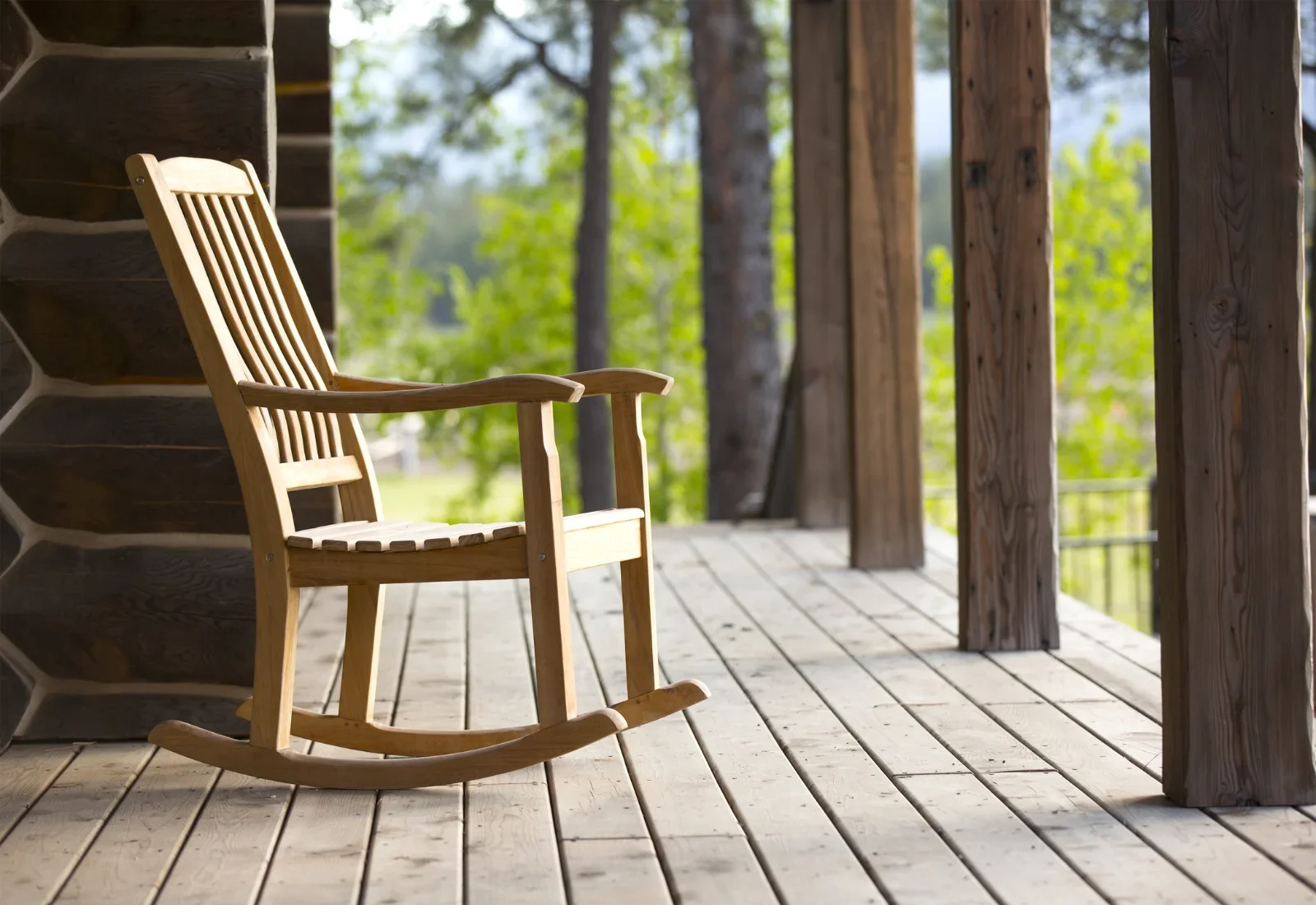
It surprised me at some point how little was required to sit there. It was freeing. Even on those hollow mornings, the chair was still there, waiting. I didn’t need conviction. I didn’t need direction. I didn’t need to believe that anything I was doing mattered. I only needed not to leave. I needed to sit with whatever drifted through my mind. The common thread behind it all was my chair, on productive days and on days of nothing. It was always sitting there, consistent, no matter where my head was. So, I returned to it, some days with more fervor than others, but always with a refusal to hand over control to the weather outside (I write outside on my porch) or even the weather, no matter how calm or turbulent, going on inside of me.
Those neutral days of nothingness were not heroic. They were days that neither lifted nor dragged, days that offered no motivational or dramatic reason or inspiration to move forward, but at the same time, no compelling reason not to be there. It seemed on those days that the world asked nothing of me other than attendance in that chair, across the lawn from the birdfeeder, pondering the processes of the past few million years.
When I think back on my own evolution now, what strikes me is not how much time I wasted sitting there, but rather how honest those hours were. Out of boredom, I did begin to tinker, but without the need or motivation to impress, accelerate, or aim beyond the moment, I moved straight to the essentials as they popped into my head. It was all rather casual. There was no adornment, no performance, no word count, no chasing of superiority. Just small, impulsive, inner-driven activities, whether rain or shine, just some sort of private continuity with days more productive, but with no invisible audience or ego applauding, but at the same time nothing left undone. When inspired, sitting in the chair, I did what I felt inspired to do, letting direction come from the nothingness.
Over time, something shifted. Those neutral (I wouldn’t call them wasted) days, those unremarkable returns to the chair each morning, began to alter the way I understood myself in the same way that I could envision lizards growing wings millions of years ago. I don’t think I ever patted myself on my back for my consistency of sitting in a chair (that hardly seems a heroic act), but I did begin to trust it as an inkling of something I couldn’t put my finger on began to take form in my consciousness, in my being. Showing up and sitting down, I began to sense that I did not need to feel aligned with my work or even with myself to remain connected. Just drink coffee and watch the birds, and occasionally look at my computer screen. I didn’t need the weather, inside or out, to give me permission. Before I stepped into the day, I needed to go to my chair and sit. And, surprise to me, somewhere along the way, my fingers would find their way to the keyboard, and I would start to type. Somewhere by the end of the day, I would pause and look back on all that I had accomplished, even though I had had no preplanned direction.
Trust accumulated in ways I couldn’t have articulated then, but it did soften the drama around the difficulty of being aimless. It quieted the argument between desire and duty. It reframed commitment as identity rather than effort. I began to see that most of what endures in life is built not on bursts of certainty but on the steady, unimpressive, evolutionary cadence of return.
The curious, but also understandable, thing is that the work of my life didn’t constantly improve in those days, but my relationship with my work, and even myself, did. Sitting down in my chair became less conditional, less dependent on mood or inspiration, or the unpredictable tides of self-belief or raw motivation. Sitting down in my chair became, instead, something like a morning welcome, a companionship, coming with the predictability and comfort of knowing that the sun will rise each day and I will sit: steady, imperfect, patient.
Looking back, I never found the dramatic clarity I once believed I needed to move forward. I saw something quieter. I discovered that life continues, like birds in flight, even when eagerness does not. I found that meaning doesn’t always come hand in hand with willingness. I discovered that neutrality is fertile in its own way. We don’t need a parade; we only need a chair.
I once thought that discipline was a loud, cinematic declaration, something founded in great ambition or proven with relentless, knock-the-walls-down drive, but the truth, for me, instead lived in a place outside on the back porch, an ordinary chair, waiting without fanfare, and asking for nothing other than my presence. “Come as you are,” it called. “If nothing else,” it said in its Southern way, “just sit a spell.”
Perhaps the unexpected lesson for me is this: the parts of life that endure are not always those born from passion, certainty, or predetermination while lying in the bed in the morning and staring at the ceiling with the morning light coming in through the shutters, but instead it is from the steady, unremarkable decision to get my coffee, in my routine, and sit in my chair long enough for meaning to find its way back. The chair is always waiting.

Clay Stafford is a bestselling writer, filmmaker, and founder of the Killer Nashville International Writers’ Conference, Killer Nashville Magazine, and the Killer Nashville University streaming service. Subscribe to his newsletter at https://claystafford.com/.
Freedom Fighters: Harness the Power of Motivation and Discipline to Beat Procrastination
All writers face the inner enemy of procrastination. In this insightful and empowering guide, Mary Lynn Cloghesy and Jason Schembri explore how motivation and discipline can work together to help writers conquer resistance, build better habits, and stay on track toward their goals.
By Mary Lynn Cloghesy and Jason Schembri
One common foe all writers face, regardless of genre, is procrastination. It’s inevitable for anyone in a deadline-driven profession. Whether you are writing for yourself or a publisher, you are bound to run into this anti-hero in the dark corners of your mind, who will try to lead you down pathways that go nowhere, then abandon you at the end. If you make the long journey back to where you started, it will be waiting for you, tapping its foot, wondering what will work this time… that article you plan to write, why bother… the chapter you want to finish, no one will read it… these deadlines, all irrelevant... Even Charles Dickens has something to say on the matter: “Never do tomorrow what you can do today. Procrastination is the thief of time.”
“Procrastination” is derived from the Latin verb procrastinare—to put off until tomorrow—but it’s more complex than a simple delay. It’s a state of mind. Coleridge used the term, a “tomorrower,” in 1810 for someone caught in the grips of procrastination. Certain studies suggest it’s a strategy to manage negative emotions like self-doubt that cause you to avoid what is beneficial; others define it as intention alone without any follow-through. Regardless, it can become a self-destructive cycle. As writers, we are especially susceptible to procrastination because our rewards don’t come immediately. It can be years before any hard work pays off, particularly if you are seeking recognition by the industry, which makes this enemy even more powerful.
Add to that our propensity to judge ourselves harshly, and we can back ourselves into a corner. As Megan McArdle explains in an article in The Atlantic, “Most writers manage to get by because, as the deadline creeps closer, their fears of turning in nothing eventually surpasses their fears of turning in something terrible.” Can we do better than that? Only if we are intentional in our approach, as research has revealed that nearly 80% of our thoughts are negative and 95% are repeated on an endless loop, both of which keep us moving through a labyrinth of excuses and missed opportunities. William James, father of American psychology, has famously said, “a great many people think they are thinking, when they are merely rearranging their prejudices.”
So, how do we combat this formidable opponent? We need a team of superheroes: Motivation and Discipline. Mirriam-Webster defines motivation as “a stimulus, force, or influence,” using the word “incentive” and “drive” as comparatives, whereas discipline is described as “control gained by enforcing obedience or order,” then sadly adds “punishment” as a synonym. At first glace, the words “motivation” and “discipline” seem to be opposite in nature, so we need to unpack these terms to understand how they can beat procrastination.
At the beginning of a project when your ideas are flowing and any deadlines are in the distant future, your motivation is typically high. You want to do your chosen task, putting pen to paper (metaphorically.) Yet, procrastination is hiding in the background, silent and invisible, lying in wait. Motivation will be the first thing to come under attack, as it’s prone to the vagaries of your mood, emotions, and external influences. Enter discipline, who you might think of as the “big brother” of motivation. Discipline can help you get back on track, although its influence may be fleeting, if you resist it because you feel chastised. Clearly, these two need to work together to win the day.
Strategies to Keep You Motivated
Because motivation is higher in the early stages of writing, we’ll address it first. By training this superhero, you’ll learn to sustain your efforts, until it’s time for discipline to step in to help you accomplish your goals. Here are some tools and strategies to consider:
Use “The Five Second Rule,” by self-help author, Mel Robbins.
The premise is that when you have an idea, your brain will KILL the impulse in five seconds unless you act upon it. To apply this concept, count down from five to one, then follow-through on an action that implements or supports the idea immediately. For writers, this may mean free-writing for a few minutes to “prime the pump,” when the countdown ends, or firing up the work-in-progress that you’ve been avoiding.Ask yourself: what do you want NOW versus MOST. When you feel distracted or lose interest in your long-term goal, such as finishing a novel, it can be easy for short term “wants” to take precedence over delayed desires. This is where you need to step back and ask yourself, “what do I want NOW, and what do I want MOST?” If they happen to align, that’s great, but if not, use this question to determine what matters to you most. Alignment can and will happen more often, the more you implement this strategy.
Commit to a Mirror Moment. What is a mirror moment, you might be wondering…it’s a strategy to bring to light the fears and resistance you experience in the dark recesses of your mind. If most of our thoughts are unproductive, taking up space that could be used for creative work, then we need to call them out. More importantly, we need to recognize the internal dialogue that is disabling us by asking ourselves if what that inner voice says is true, especially when procrastination is speaking. To implement this strategy, stand in front of a mirror, and say OUT LOUD what you’re thinking. Next, ask yourself if it’s true (spoiler alert: procrastination always lies). Finally, smile and tell it to STAND DOWN. This is the transitional step where discipline can begin to take hold. It’s more powerful than you realize, although it can feel a little uncomfortable the first few times you try it.
How to Build Discipline (Without Punishment)
When considering the notion of discipline, it’s crucial to separate it from punishment. The first is positive and productive, whereas the second is painful and punitive. We can only harness the power of discipline when we embrace habit-building, which is a proactive approach to achieving our goals versus a reactive response to missing our objectives. Writers are hard enough on themselves, right? Our contributions to the craft and canon of writing can, and should, begin with diligent self-care and kindness for ourselves and others. Having clarified that point, let’s consider some strategies to build discipline:
Make Some Space: Sometimes, you’ll experience a legitimate lack of time in your day for writing, but you can do something about that. Try an exercise called Start/Stop/Continue. Find one thing you want to start, preferably writing, then find something that is occupying time that is not beneficial to your forward progression and commit to stop doing it. Anything within your current routine that serves you well can be acknowledged and retained. In this way, you won’t continually add more work to your schedule as you’ll substitute one thing (writing, reading, research time) and stop another. Overburdening yourself creates overwhelm, which fuels procrastination.
“Piggyback” New Habits on Existing Ones: It can feel difficult to build a habit in isolation, so it may help to “piggyback” a new habit on top of an existing one that you already enjoy. For example, we both enjoy our morning coffee, so we decided to “piggyback” our first writing session with that habit. As soon as our cups are filled, we each sit at our desks and fire up our works-in-progress. Now, that these habits are successfully paired, it feels strange not to follow-through. The beauty of piggybacking is that it accelerates the adherence to a new habit, while also creating time efficiency.
Healthy Living Top Tip
Our healthy living top tip this month is to build consistency through repetition. “Persistence in resistance” beats procrastination, every time. It helps to think of writing as a practice, one that requires regular attention, even for short intervals. Protective discipline can’t be built on a one-time effort, but when you string your efforts together on daily basis, for many days in succession, a new habit is formed, and discipline becomes the perfect partner to motivation. Together, they are a dynamic duo that will help you cross the finish line of any writing project.
Freedom Fighters Working for You
Procrastination is one of our biggest enemies, and it is ever-present. If we want to succeed in our writing, we need to be deliberate in our strategy and use strong tools to overcome it. Thankfully, we have the freedom fighters of motivation and discipline by our side. Reviewing our goals on a regular basis will enhance our probability of success too, so procrastination doesn’t take us by surprise. While some effort is involved in building and tracking new habits, consider what science fiction writer Douglas Adams says about the rewards, “I love deadlines. I love the whooshing noise they made as they go by.” Now, start counting down, 5-4-3-2… and head straight to the mirror for a heart-to-heart with yourself about your writing, acknowledging how much it matters.
Mary Lynn formerly co-owned a therapeutic clinic, and Jason is a long-term weight loss and healthy living coach. Together, they host a writing and hiking retreat in the Canadian Rockies.

Submit Your Writing to KN Magazine
Want to have your writing included in Killer Nashville Magazine?
Fill out our submission form and upload your writing here: