Drop the Pen! What Every Writer Needs to Know About Real Police Work: Police Batons
By David Lane Williams
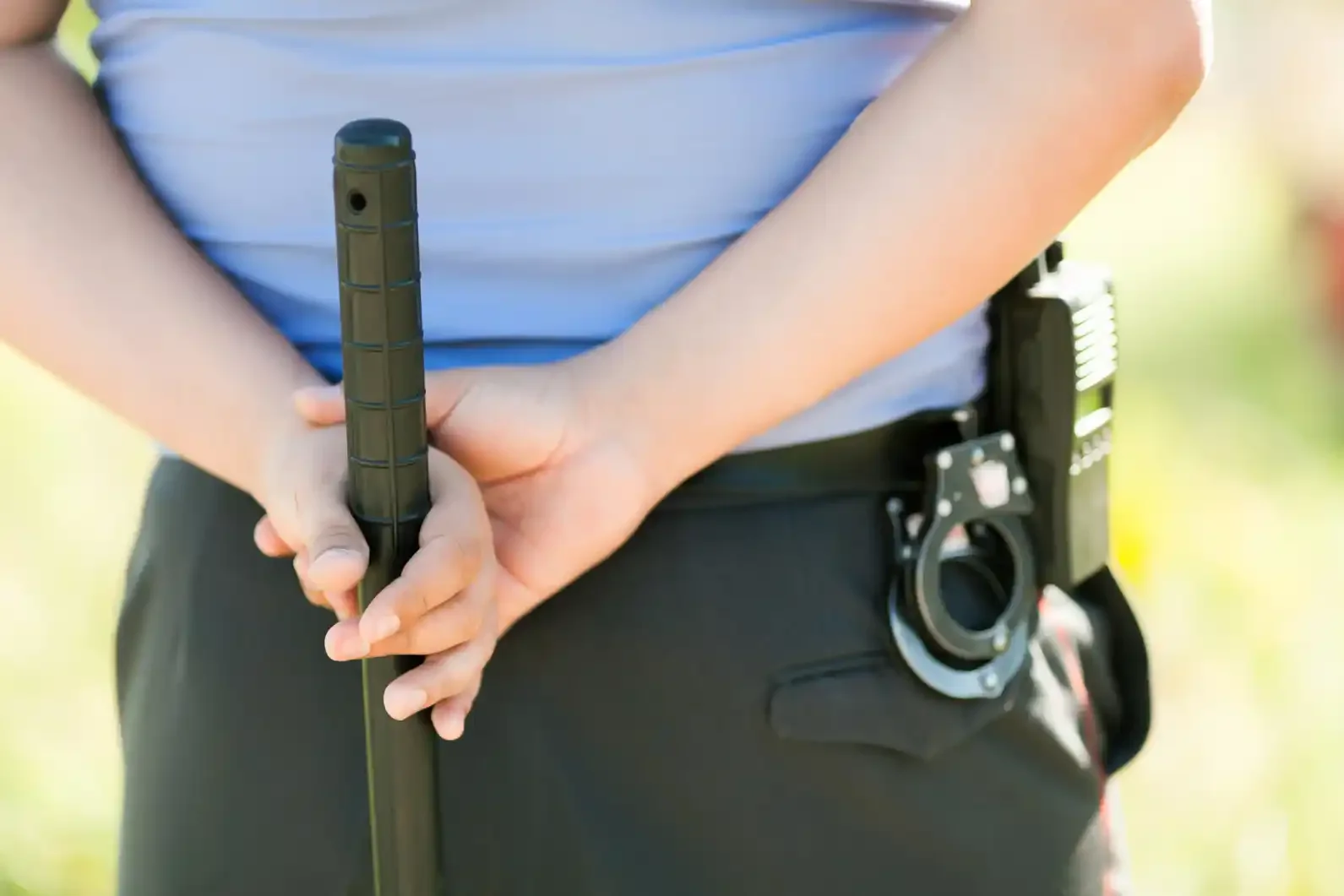
One of the most frequently asked questions I get at writer’s events when I speak or sit on discussion panels has to do with police weapons other than firearms. Writers want to understand how and when such tools are utilized, as well as the training involved. Tasers and pepper spray always come up, but occasionally someone wants to get a better grasp on police batons for a scene they're writing.
One of the early roles in policing in Western Europe and the fledgling American colonies was that of the Night Watchman. Often these people patrolled what we would now call the Red-Light district of his town or city, charged with keeping the peace—or at least keeping the ruckus relatively quiet so that the folks in the swanky part of town weren’t disturbed. There was no training curriculum or written policy manual. The men hired on (often just for a night or two to make enough for a few pints) were almost always from the same neighborhood they patrolled, often just as likely to get into a knife fight, gamble, or hire a lady of the evening as the people they’d been hired to manage.
A night watchman was usually a large fellow, willing to get into a physical scrape but menacing enough that most people wouldn’t take him on. Just in case, though, night watchmen are always depicted as carrying some type of club. This “billy club,” a name derived from burglar slang for a short bar or length of wood used to pry or bust windows, became a symbol for the long (and potentially brutal) arm of the law.
Flash forward in history to Rodney King, a man whose assault at the hands of Los Angeles police officers after a high-speed pursuit was filmed on a newfangled device called a handheld video recorder in 1991. The footage of the incident was seen by millions internationally, and a new era of the public documenting and broadcasting actions taken by their government began.
The officers who struck King so relentlessly were using a style of baton called the PR 24. The PR 24 came with a handle jutting out perpendicular from one end of the stick, which allowed for a variety of techniques, such as swinging it with greater speed, using it on body pressure points, and gripping it in a way that allowed for greater protection against a blow from a blunt object or a slashing knife blade.
The outcry after the Rodney King assault was so loud and angry that police chiefs and sheriffs across the land pulled the PR24 off the streets. That was fine with most patrol officers because the old-style batons were already falling out of use. I suppose they were a reasonable tool back in the days when cops primarily walked a beat, but they were lousy for getting in and out of a car. For that reason, most guys took them out of their belts and laid them on the passenger seat while driving around their districts. This resulted in batons being left behind in the car when the officer got out to address an emergency or chase a suspect on foot.
Enter the expandable baton. This form of “nightstick” is about 9 inches long when collapsed, but some models can extend to nearly 3 feet with the flick of a wrist. This makes them ideal for carrying in a leather holster on one’s duty belt, making it much easier to get into and out of the squad car. They’re also less intimidating than a full-length bat-style or PR24 baton, which is better for officers out there trying to forge positive relationships in the community.
In my Texas police academy, cadets were expected to take one strike to the outer thigh with the baton. Our academy chief was a sadistic marine with sociopathic tendencies. He was an inch or two over six feet, muscular, Mr. Clean bald with an angry brow line. The only time I ever saw him smile was when I was doing pushups (usually for laughing while standing at attention), or on the day he was hitting us with that damn baton. I remember him raising that nightstick back behind his shoulder and slamming it sideways into my left thigh with all the power in his frame. I collapsed to the ground as I squeezed my throbbing leg and bit my lower lip to keep from wailing like a lost calf. I didn’t walk right for weeks.
Ah, training.
A police baton falls into the category of “less lethal” on the force continuum, meaning it is not intended to inflict a mortal wound but could if it strikes the head, throat, or neck. Training and policy dictate that a baton strike be aimed at the limbs, and only in a situation that has turned violent. It is not to be utilized as an implement of punishment, and any such use of force should be documented and investigated to ensure the officer wielding the weapon used reasonable force in the moment.
I only used my baton four times during my career. Two of those were to break and rake a window to gain entry during manhunts. Another time, I cracked the windshield of a guy stoned out of his gourd while driving his pickup through an outdoor concert crowd. I was running alongside his truck, yelling at him to stop, but he was so high he didn’t even know I was there until I started whacking his truck with that metal stick.
He stopped.
The only time I struck a human with a baton was on a fellow who had pulled a pair of scissors on his ex-girlfriend. Before he pulled the scissors, the ex was taunting him in front of me with her new boyfriend, saying all manner of cruel things about his manhood. I couldn’t let him stab her with the scissors, but I felt bad for the guy even as I hit him with all I had. I’ll never forget his face: anguish, heartbreak, agony, and surprise all showing at the same time. It was a rough way to learn about toxic relationships.
It is possible that some of you might want to incorporate a police baton into the story of a future work in progress. Feel free to shoot me an email if you have more questions on the topic (or others related to authentic police work for writers). Happy to get you squared away in that regard, and I won’t even make you take a baton strike to the leg.
Carry on.